Cubism
***Find two videos on Cubism. Watch them through. Add the links to the videos in an email and share them with me. There is also a quiz at the bottom of this page to add to your email.
General Overview
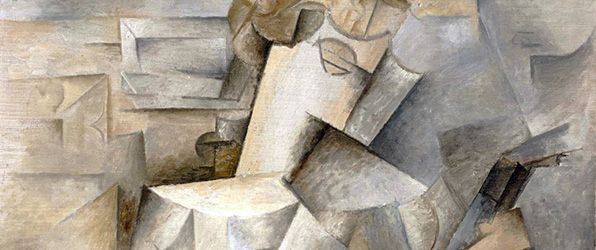
Cubism was an innovative art movement pioneered by Pablo Picasso and Georges Braque. In Cubism, artists began to look at subjects in new ways in an effort to depict three-dimensions and movement on a flat canvas. They would break up the subject into many different shapes and then repaint it from different angles. Cubism paved the way for many different modern movements of art in the 20th century.
When was the Cubism movement?
The movement started in 1908 and lasted through the 1920s.
What are the characteristics of Cubism?
There were two main types of Cubism:
Violin and Candlestick (Georges Braque)
This is an early example of Analytical Cubism. In the painting you can see the broken up pieces of the violin and the candlestick. Many different angles and blocks of the objects are presented to the viewer. Braque said that this style allowed the viewer to "get closer to the object." You can see this picture here.
Three Musicians (Pablo Picasso)
This painting by Pablo Picasso was one of his later works in Cubism and is an example of Synthetic Cubism. Although it looks like the picture is made out of cut up pieces of colored paper, it is actually a painting. In the painting it is difficult to tell where one musician ends and the next begins. This could represent the harmony of the music as the musicians play together. You can see this picture here.
Portrait of Picasso (Juan Gris)
Cubism was also used to paint portraits. In this example of Analytical Cubism, Juan Gris pays tribute to the inventor of Cubism Pablo Picasso. Like many early Cubism paintings, this painting uses cool blues and light browns for colors. The lines between the different blocks are well defined, but Picasso's facial features can still be recognized.
Famous Cubism Artists
QUIZ:
Within your email with your video links answer the following questions:
1. When did the Cubism art movement take place?
a. 1200s
b. Late 1400s to early 1500s
c. Mid 1600s
d. Early 1900s
e. Late 1900s to early 2000s
2. The two main types of Cubism were Analytical Cubism and ______ Cubism?
a. Expressive
b. Synthetic
c. Constructive
d. Destructive
e. Computational
3. What two artists were largely responsible for inventing Cubism?
a. Picasso and Braque
b. Metzinger and Leger
c. Munch and Simberg
d. Klimt and Cezanne
e. Van Gogh and Manet
4. What Cubism artist wrote the first major essay on Cubism and painted 'Woman with a Fan'?
a. Georges Braque
b. Juan Gris
c. Jean Metzinger
d. Pablo Picasso
e. Fernand Leger
5. What artist painted 'Three Musicians' and was a primary founder of the Cubism movement?
a. Georges Braque
b. Juan Gris
c. Jean Metzinger
d. Pablo Picasso
e. Fernand Leger
6. What Spanish artist painted 'Portrait of Picasso' and helped develop Synthetic Cubism?
a. Georges Braque
b. Juan Gris
c. Jean Metzinger
d. Pablo Picasso
e. Fernand Leger
7. What co-founder of Cubism painted 'Violin and Candlestick'?
a. Georges Braque
b. Juan Gris
c. Jean Metzinger
d. Pablo Picasso
e. Fernand Leger
8. What artist used popular subjects in his art and helped to inspire the creation of Pop Art?
a. Georges Braque
b. Juan Gris
c. Jean Metzinger
d. Pablo Picasso
e. Fernand Leger
9. True or False: The most common subject in the Cubism art movement was landscapes.
a. TRUE
b. FALSE
10. What style of Cubism focused on bright colors and the relationship between painting and music?
a. Expressionism
b. Musicism
c. Orphism
d. Colorism
e. Surrealism
Cubism was an innovative art movement pioneered by Pablo Picasso and Georges Braque. In Cubism, artists began to look at subjects in new ways in an effort to depict three-dimensions and movement on a flat canvas. They would break up the subject into many different shapes and then repaint it from different angles. Cubism paved the way for many different modern movements of art in the 20th century.
When was the Cubism movement?
The movement started in 1908 and lasted through the 1920s.
What are the characteristics of Cubism?
There were two main types of Cubism:
- Analytical Cubism - The first stage of the Cubism movement was called Analytical Cubism. In this style, artists would study (or analyze) the subject and break it up into different blocks. They would look at the blocks from different angles. Then they would reconstruct the subject, painting the blocks from various viewpoints.
- Synthetic Cubism - The second stage of Cubism introduced the idea of adding in other materials in a collage. Artists would use colored paper, newspapers, and other materials to represent the different blocks of the subject. This stage also introduced brighter colors and a lighter mood to the art.
Violin and Candlestick (Georges Braque)
This is an early example of Analytical Cubism. In the painting you can see the broken up pieces of the violin and the candlestick. Many different angles and blocks of the objects are presented to the viewer. Braque said that this style allowed the viewer to "get closer to the object." You can see this picture here.
Three Musicians (Pablo Picasso)
This painting by Pablo Picasso was one of his later works in Cubism and is an example of Synthetic Cubism. Although it looks like the picture is made out of cut up pieces of colored paper, it is actually a painting. In the painting it is difficult to tell where one musician ends and the next begins. This could represent the harmony of the music as the musicians play together. You can see this picture here.
Portrait of Picasso (Juan Gris)
Cubism was also used to paint portraits. In this example of Analytical Cubism, Juan Gris pays tribute to the inventor of Cubism Pablo Picasso. Like many early Cubism paintings, this painting uses cool blues and light browns for colors. The lines between the different blocks are well defined, but Picasso's facial features can still be recognized.
Famous Cubism Artists
- Georges Braque - Braque is one of the founding fathers of Cubism along with Picasso. He continued to explore Cubism for much of his art career.
- Robert Delaunay - Delaunay was a French artist who created his own style of Cubism called Orphism. Orphism focused on bright colors and the relationship between painting and music.
- Juan Gris - Gris was a Spanish artist who became involved in Cubism early on. He also was a leader in the development of Synthetic Cubism.
- Fernand Leger - Leger had his own unique style within Cubism. His art began to focus on popular subjects and was an inspiration to the creation of Pop Art.
- Jean Metzinger - Metzinger was a artist and writer. He explored Cubism from a scientific standpoint as well as an artistic one. He wrote the first major essay on Cubism. Some of his famous paintings include The Rider: Woman with a Horse and Woman with a Fan.
- Pablo Picasso - The primary founder of Cubism, together with Braque, Picasso explored a number of different styles of art throughout his career. Some say that he produced enough innovative and unique art for five or six different famous artists.
- The artwork of Paul Cezanne is said to have been one of the main inspirations for Cubism.
- Picasso and Braque did not think Cubism should be abstract, but other artists, such as Robert Delaunay, created more abstract work. In this way Cubism eventually helped to spawn the Abstract Art movement.
- Picasso also worked on Cubist sculpture including his sculpture Head of a Woman.
- Popular subjects for Cubism included musical instruments, people, bottles, glasses, and playing cards. There were very few Cubist landscapes.
- Pablo Picasso and Georges Braque worked closely together in developing this new art form
QUIZ:
Within your email with your video links answer the following questions:
1. When did the Cubism art movement take place?
a. 1200s
b. Late 1400s to early 1500s
c. Mid 1600s
d. Early 1900s
e. Late 1900s to early 2000s
2. The two main types of Cubism were Analytical Cubism and ______ Cubism?
a. Expressive
b. Synthetic
c. Constructive
d. Destructive
e. Computational
3. What two artists were largely responsible for inventing Cubism?
a. Picasso and Braque
b. Metzinger and Leger
c. Munch and Simberg
d. Klimt and Cezanne
e. Van Gogh and Manet
4. What Cubism artist wrote the first major essay on Cubism and painted 'Woman with a Fan'?
a. Georges Braque
b. Juan Gris
c. Jean Metzinger
d. Pablo Picasso
e. Fernand Leger
5. What artist painted 'Three Musicians' and was a primary founder of the Cubism movement?
a. Georges Braque
b. Juan Gris
c. Jean Metzinger
d. Pablo Picasso
e. Fernand Leger
6. What Spanish artist painted 'Portrait of Picasso' and helped develop Synthetic Cubism?
a. Georges Braque
b. Juan Gris
c. Jean Metzinger
d. Pablo Picasso
e. Fernand Leger
7. What co-founder of Cubism painted 'Violin and Candlestick'?
a. Georges Braque
b. Juan Gris
c. Jean Metzinger
d. Pablo Picasso
e. Fernand Leger
8. What artist used popular subjects in his art and helped to inspire the creation of Pop Art?
a. Georges Braque
b. Juan Gris
c. Jean Metzinger
d. Pablo Picasso
e. Fernand Leger
9. True or False: The most common subject in the Cubism art movement was landscapes.
a. TRUE
b. FALSE
10. What style of Cubism focused on bright colors and the relationship between painting and music?
a. Expressionism
b. Musicism
c. Orphism
d. Colorism
e. Surrealism


